
Posted by Nastech on 15th Sep 2026
No Grid. No Backup Generators. No Single Point of Failure: How You Design a Power System That Lives on Its Own
Case Study | Nastech Solar
Imagine a facility that needs continuous, uninterrupted electricity — but has no connection to the public power grid, and no fallback to it under any circumstance. No "backup plan" that leans on the grid. No grid presence in the equation at all. The entire facility lives on its own system, carrying sole responsibility for every watt it consumes.
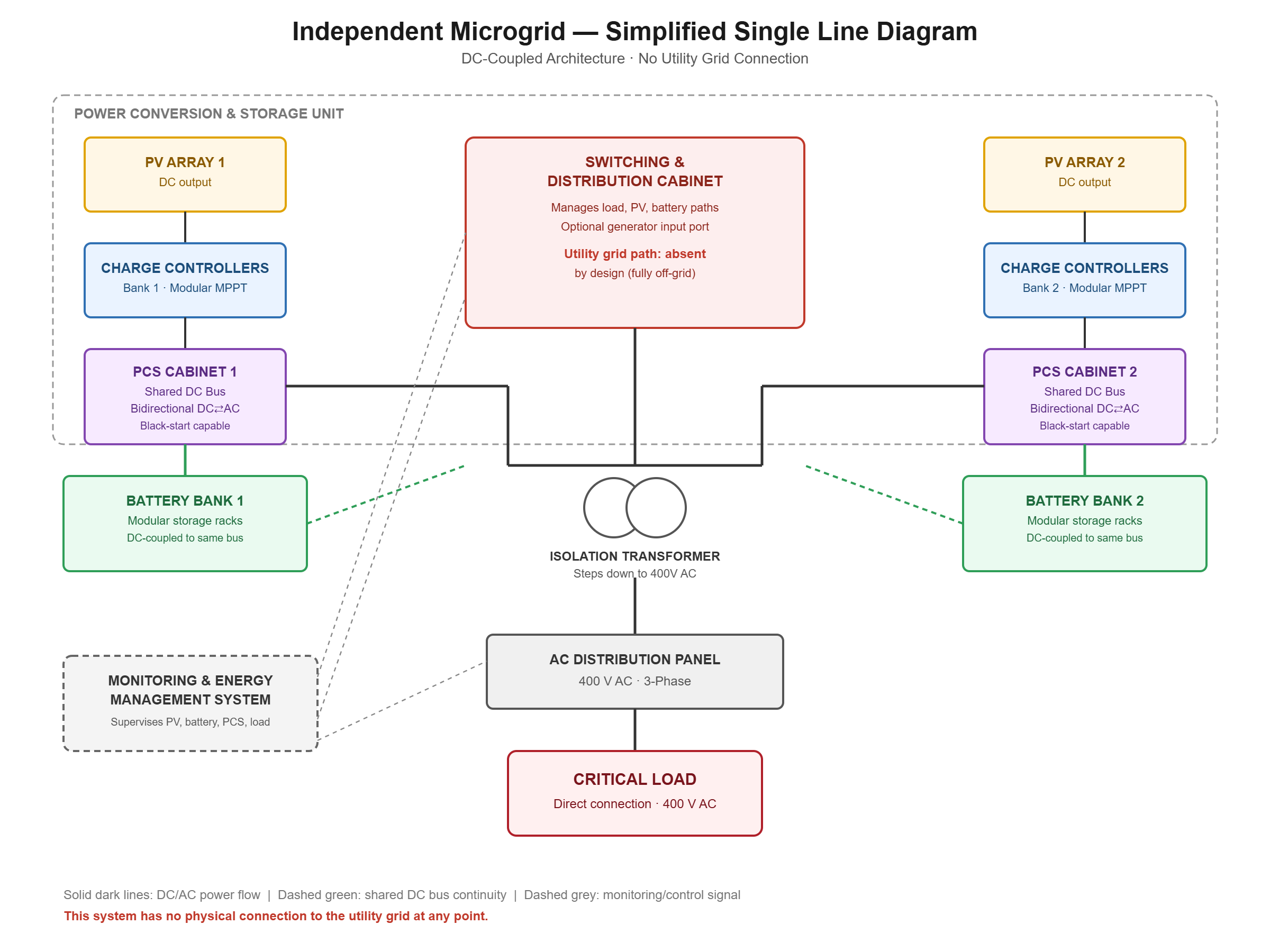
That's exactly the core of a project we recently designed: a fully independent microgrid for a critical 1MW load, fed directly at 400V AC — with no connection to the national grid whatsoever, not as a primary source and not even as an emergency backup. The system's only source of power, from the first moment of operation to the very last watt consumed, is a solar-plus-storage system engineered to carry the entire load on its own.
The Challenge: Genuine Independence, Not Just a Backup Copy
In conventional grid-tied systems, solar and batteries are often an "add-on" — something that trims the bill or supports the grid during peak demand. But when a facility is completely isolated from the grid, the rules of the game change entirely:
- Solar generation is no longer optional — it's the sole source of daily renewable energy
- Batteries are no longer for peak-shaving — they're the only lifeline through the night and cloudy days
- Every component in the chain has to be designed around a single question: "What happens if this specific part fails?"
This is where the real engineering question emerges: how many days of autonomy do you actually need? One day? Two? More? The answer directly determines battery sizing — and battery sizing determines everything else in the design, from converter capacity to the physical footprint of the site itself.
The goal of this project wasn't simply to "reduce grid dependency." The objective was more explicit and more demanding than that: connect the system directly to the load at 400V AC, with no intermediary, and with no external grid present in the equation from the outset. No backup transmission line. No fallback to the utility in an emergency. Not a single point of connection to any source outside the facility's own boundaries. This is the true definition of an "independent microgrid" — a system that lives and breathes entirely on its own.
The Solution Concept: One System, Three Interconnected Layers
Regardless of the finer details, any solution for this type of project rests on three fundamental layers working together as a single integrated system:
Layer One — Generation: A solar array sized to exceed the actual load by a deliberate safety margin. Why the extra margin? Because a cloudy day, dust accumulation, or even a slight deviation in the angle of incidence all mean lower-than-ideal output. The system has to absorb that reality without ever threatening continuity of supply.
Layer Two — Storage: A battery bank sized not just around "how many kilowatt-hours do we need," but around safe depth of discharge, the expected number of charge/discharge cycles over the project's lifetime, and performance behaviour across different temperatures. A battery sized incorrectly today means premature replacement costs tomorrow.
Layer Three — Conversion & Control: The component that ties everything together — converting power from DC to AC and delivering it directly at 400V to the load's point of connection, with no intermediate station and no external link. This component also carries the single most important capability in any fully grid-isolated system: black start capability — the ability for the system to start itself from zero with no external source whatsoever. No grid, no backup source, nothing but the system itself. This, incidentally, is a capability that's often overlooked in less mature designs.
A Decision That's Often Made Too Quickly
One of the most consequential decisions in projects like this — and one of the least given the time it deserves — is: how does the solar generation source connect to the storage system? Do they share the same internal conversion path directly, or does each have its own independent unit, meeting only downstream?
This isn't a minor technical detail. It has a direct impact on:
- Overall system efficiency (every additional conversion step means additional energy loss)
- Future expansion flexibility
- Total project cost
- Ease of maintenance and partial replacement in the event of a fault
Unfortunately, this is precisely the kind of decision that sometimes gets made based on what's "available" rather than what's actually right for the load and the site.
Why This Matters for Any Critical Facility
Whether your facility is a hospital, a data center, an industrial plant, or any site that cannot tolerate a power interruption, the same principles apply: load size, the number of autonomy days required, and the way power sources are interconnected are the three factors that determine a project's success or failure — before equipment or suppliers even enter the conversation.
The Bottom Line
Designing a power system that's fully independent from the grid isn't simply "scaling up" a standard solar system with bigger batteries bolted on. It's a complete engineering undertaking that begins with a precise understanding of the load, moves through sensitive architectural decisions, and ends with a system that's meant to operate silently for years without anyone noticing it's there — until the moment it's needed most.
If your facility needs this same level of independence and reliability, we'd be glad to discuss your project's specific details and put together a tailored quote that accounts for your load profile, your site, and your continuity requirements.
Talk to our team today to start scoping your project and get the right quote.
Nastech Solar — Home of Clean Energy.